
Regelventile für Wasserstoff: Werkstoff, Dichtheit nach außen und Spindelabdichtung – was anders ist als bei Dampf und Gas
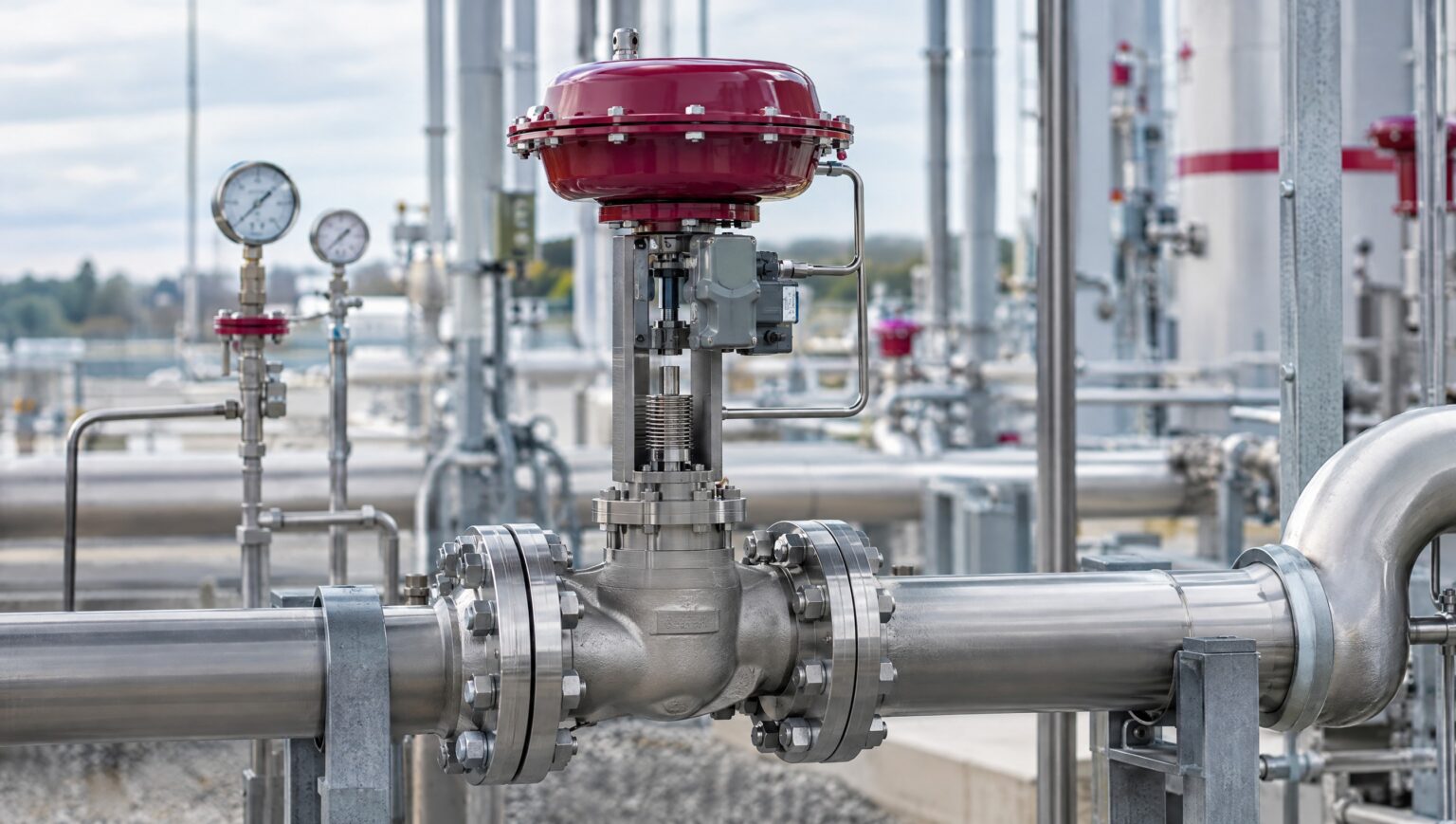
Wer ein Regelventil für Wasserstoff auswählt, stellt zunächst dieselben Fragen wie bei Dampf oder Erdgas: Durchfluss, Vordruck, Nachdruck, Kennlinie, Antrieb. Bei Regelventilen für Wasserstoff kommen aber drei Punkte dazu, die beim Vergleich von Datenblättern gern untergehen: der Gehäusewerkstoff, die Dichtheit nach außen und die Abdichtung der Spindel. Dieser Beitrag zeigt, was sich gegenüber Dampf und Gas ändert, welche Werte der Hersteller RTK für seine Wasserstoff-Ausführung angibt und woran Sie erkennen, ob eine Stopfbuchspackung genügt oder ein Faltenbalg nötig ist.
Was Wasserstoff von Dampf und Erdgas unterscheidet
Drei Eigenschaften machen den Unterschied. Erstens ist Wasserstoff das kleinste Molekül überhaupt. Er findet Wege durch Spalte und Kunststoffdichtungen, die bei Erdgas als dicht gelten. Zweitens ist der Zündbereich in Luft sehr breit und beginnt bereits bei rund 4 Vol.-%; die Flamme ist bei Tageslicht kaum zu sehen. Drittens wird Wasserstoff an Metalloberflächen adsorbiert und kann in das Gefüge eindringen. Dieser Vorgang heißt Wasserstoffversprödung und kann bestimmte Stähle mit der Zeit rissanfällig machen.
Für das Regelventil folgt daraus eine andere Gewichtung. Bei Dampf ist eine undichte Stopfbuchse sichtbar und hörbar, sie wird beim nächsten Rundgang nachgezogen. Bei Wasserstoff sammelt sich ausgetretenes Gas unbemerkt, etwa unter einer Einhausung oder in einem schlecht belüfteten Armaturenraum. Die kritische Leckage ist deshalb nicht der Durchgang am Sitz, sondern das, was an Spindel und Deckeldichtung in die Umgebung gelangt.
RTK nennt als Einsatzmedien seiner Wasserstoff-Ausführung sowohl reinen Wasserstoff als auch Gemische aus Wasserstoff und Erdgas. Für Beimischungen gelten dieselben Überlegungen in abgeschwächter Form: Schon ein Wasserstoffanteil verändert das Dichtverhalten gegenüber reinem Erdgas, und die Anforderungen der Prüfstelle richten sich nach dem tatsächlichen Gemisch.
Gehäusewerkstoff: Stahlguss oder Edelstahlguss
Wasserstoffversprödung trifft vor allem höherfeste ferritische Stähle. Verstärkt wird sie durch hohen Wasserstoff-Partialdruck, Spannungsspitzen im Bauteil und wechselnde Last. Austenitische Chrom-Nickel-Molybdän-Stähle gelten als deutlich weniger empfindlich.
RTK bietet Gehäuse und Deckel wahlweise in Stahlguss 1.0619 (SA 216 WCB) oder in Edelstahlguss 1.4408 (SA 351 CF8M) an. Beim Stahlguss begrenzt der Hersteller die Härte auf höchstens 22 HRC in Anlehnung an NACE MR 0175 und führt das ausdrücklich als Maßnahme gegen Versprödung und Rissbildung an.
Welcher Werkstoff gewählt wird, hängt in der Praxis von Druckstufe, Temperatur, Häufigkeit der Druckwechsel und den Vorgaben von Betreiber und Prüfstelle ab. Bei hohen Drücken und häufigen Lastwechseln liegt Edelstahlguss nahe. Bei moderaten Drücken, etwa in einem Netz mit Beimischung, kann härtebegrenzter Stahlguss ausreichen. Festgelegt wird das gemeinsam mit Planer und Prüfstelle, denn eine eigene Konstruktionsnorm für Wasserstoff-Regelventile gibt es nach Angabe von RTK nicht. Der Hersteller arbeitet mit einem Werksstandard, der Druckgeräterichtlinie, ASME, DIN und NACE zusammenführt, und nennt ISO 19880-3 sowie ISO/TR 15916 als Bezugsdokumente.
Garnitur und Kegel: Werkstoff nach Differenzdruck wählen
Die Innenteile der RTK-Wasserstoff-Ausführung sind aus 1.4571. Für den Kegel stehen 1.4571 oder Stellite 6 zur Wahl, Letzteres für hohe Differenzdrücke. Der Grund: Wasserstoff ist sehr leicht. Bei gleichem Massenstrom strömt er mit deutlich höherer Geschwindigkeit als Erdgas, und bei großem Druckabbau werden Kegel und Sitz entsprechend stärker beansprucht, durch Erosion ebenso wie durch Geräusch.
An Garnituren führt RTK schnell öffnende Auf-Zu-Kegel, V-Port-Kegel, Lochkegel, Parabolkegel und eine Schnellwechsel-Sitzgarnitur (Quick Change Seat) in einer und zwei Stufen. Für großen Druckabbau sind Lochkegel und mehrstufige Garnituren die naheliegende Wahl, weil sie den Druck in mehreren Schritten abbauen. Die Kennlinie selbst wird wie bei jedem anderen Regelventil nach der Regelaufgabe gewählt; daran ändert der Wasserstoff nichts.
Bei der Auslegung wirkt sich die geringe Dichte direkt aus. Der Kvs-Wert wird für Gase über Volumenstrom, Dichte und Druckverhältnis berechnet. Ein Ventil, das für einen bestimmten Erdgas-Volumenstrom passt, ist bei Wasserstoff mit gleichem Energieinhalt anders dimensioniert, weil Wasserstoff je Kubikmeter deutlich weniger Energie mitbringt und dafür ein größerer Volumenstrom nötig ist. Wer eine bestehende Anlage auf Wasserstoff oder eine höhere Beimischung umstellt, sollte die Ventilauslegung deshalb neu rechnen lassen und nicht nur die Werkstoffe prüfen.
Spindelabdichtung bei Regelventilen für Wasserstoff: Faltenbalg oder Packung
Das ist die eigentliche Kernfrage. RTK bietet zwei Ausführungen an: eine Faltenbalgabdichtung aus 1.4571 und eine Stopfbuchspackung aus PTFE mit Tellerfedern.
Faltenbalg: Der Balg ist zwischen Spindel und Deckel dicht angeschlossen und trennt das Medium vom Spindeldurchgang. Die Spindel bewegt sich, ohne dass eine Gleitdichtung mit dem Wasserstoff in Berührung kommt. Eine Verdrehsicherung aus Kupferlegierung verhindert, dass der Balg auf Torsion beansprucht wird. RTK gibt den Balg für Temperaturen bis 400 °C und höchstens 100 bar bei ASME Class 150 an. Wichtig ist eine Fußnote im Datenblatt: Die TA-Luft-Zulassung des Balgs liegt nur für 40 bar vor.
Stopfbuchspackung: Die Packung besteht aus PTFE mit Kohle- und Aramidfasern und hat eine Zulassung nach TA Luft. Vorgespannte Tellerfedern führen die Pressung nach, wenn sich die Packung setzt. Einsatzgrenzen laut Hersteller: bis 250 °C und 160 bar beziehungsweise Class 900.
Wann was? Der Faltenbalg ist die Wahl, wenn ein Austritt in die Umgebung so weit wie möglich ausgeschlossen werden soll: bei Aufstellung in Gebäuden oder Einhausungen, bei reinem Wasserstoff und dort, wo das Explosionsschutzkonzept eine strenge Zoneneinteilung vorsieht. Die Packung kommt in Frage, wenn der Druck über dem Bereich liegt, für den der Balg nachgewiesen ist, oder wenn das Ventil im Freien gut belüftet steht und die Leckrate der Packung im Explosionsschutzdokument berücksichtigt ist. Diese Abwägung trifft der Betreiber mit seinem Planer. Wir liefern dafür die Daten des jeweiligen Ventils.
Dichtheit am Sitz und nach außen: zwei verschiedene Werte
Im Datenblatt stehen zwei Dichtheitsangaben, die oft verwechselt werden. Die Sitzleckrate beschreibt, was im geschlossenen Zustand durch das Ventil strömt. RTK gibt für die Wasserstoff-Ausführung Leckrate Klasse IV nach IEC 60534 an, metallisch dichtend. Das passt für ein Stellglied, das regelt. Ein Regelventil ist aber kein Absperrorgan. Wo dicht abgesperrt werden muss, gehört zusätzlich ein Absperrventil in die Leitung, und wo im Störfall schnell geschlossen werden muss, ein Sicherheits-Schnellschlussventil.
Die Dichtheit nach außen betrifft Spindel und Deckeldichtung. Als Nachweis wird im deutschsprachigen Raum häufig die TA Luft herangezogen, international die Normenreihe ISO 15848 mit ihren Leckageklassen für Spindelabdichtungen. Beim Lesen eines Datenblatts lohnt es sich zu prüfen, für welchen Druck und welche Temperatur ein Nachweis gilt. Die oben genannte Fußnote zum Balg zeigt, warum: Der Balg ist bis 100 bar einsetzbar, der TA-Luft-Nachweis reicht bis 40 bar.
Die Deckeldichtungen der RTK-Ausführung sind aus PTFE TFM, laut Hersteller für Wasserstoff geeignet.
Antrieb, Explosionsschutz und Anschluss
Für den Explosionsschutz unterscheidet RTK zwei Fälle. Mit pneumatischem Antrieb liegt eine ATEX-Bescheinigung für das komplette Ventil vor. Mit elektrischem Antrieb gilt sie nur für das Ventil; der Antrieb braucht dann eine eigene Eignung für die jeweilige Zone. Bei pneumatischen Antrieben sind Stellungsregler, Magnetventile und Endlagenschalter ebenfalls in der passenden Ex-Ausführung zu wählen.
Die Anschlussdaten laut Hersteller: Nennweiten DN 15 bis DN 150 (NPS ½ bis 6), Druckstufen PN 16 bis PN 160 sowie ASME Class 150 bis 900, Flansche nach DIN EN 1092-1 oder ASME B16.5. Der Temperaturbereich reicht von −29 °C (bei DIN-Ventilen −10 °C) bis 200 °C. Die Ventile tragen die CE-Kennzeichnung. Alle Baureihen finden Sie auf der Seite Regelventile.
Was in Ihre Anfrage gehört
Damit das Angebot ohne Rückfragen passt, brauchen wir folgende Angaben:
- Medium: reiner Wasserstoff oder Anteil im Erdgas, Reinheit
- Betriebs- und Auslegungsdruck, minimale und maximale Temperatur
- Durchfluss minimal, normal und maximal, jeweils mit Vordruck und Nachdruck
- Nennweite, Druckstufe und Flanschnorm (DIN oder ASME)
- Aufstellung: Gebäude oder im Freien, Ex-Zone
- Antrieb: pneumatisch oder elektrisch, Sicherheitsstellung bei Ausfall der Hilfsenergie
- geforderte Nachweise: TA Luft, ISO 15848, Werkstoffzeugnisse
Die Ing. Wilhelm Friedrich Gesellschaft m. b. H. vertritt RTK Regeltechnik exklusiv in Österreich. Für Inbetriebnahme, Prüfung und Tausch vor Ort steht unsere Serviceabteilung zur Verfügung, in Österreich ebenso wie in Tschechien, der Slowakei, Ungarn, Slowenien und Italien.
Häufige Fragen
Kann ein vorhandenes Erdgas-Regelventil für Wasserstoff weiterverwendet werden?
Nicht ohne Prüfung. Zu bewerten sind Gehäusewerkstoff und Härte, Dichtungswerkstoffe, die Art der Spindelabdichtung und die vorhandenen Nachweise. Bei einer geringen Beimischung fällt die Bewertung anders aus als bei reinem Wasserstoff. Entschieden wird mit Betreiber und Prüfstelle.
Ist Edelstahlguss immer die richtige Wahl?
Nicht zwingend. Er ist die naheliegende Wahl bei hohen Drücken und häufigen Druckwechseln. Für moderate Bedingungen bietet RTK härtebegrenzten Stahlguss 1.0619 an. Entscheidend sind die Betriebsdaten.
Reicht Leckrate Klasse IV am Sitz?
Für die Regelaufgabe ist Klasse IV üblich. Muss die Leitung dicht abgesperrt werden, übernimmt das eine eigene Absperrarmatur.
Gibt es eine Norm speziell für Wasserstoff-Regelventile?
Laut RTK keine eigene Konstruktionsnorm. Als Bezugsdokumente dienen ISO 19880-3 für Armaturen in Wasserstofftankstellen und ISO/TR 15916 zur Sicherheit von Wasserstoffsystemen, ergänzt um Druckgeräterichtlinie, ASME, DIN und NACE.
Fazit: drei Fragen vor der Bestellung
Welcher Gehäusewerkstoff passt zu Druck und Lastwechseln? Genügt eine Packung, oder braucht es einen Faltenbalg? Und für welchen Druck gelten die Dichtheitsnachweise tatsächlich? Wer diese drei Fragen beantwortet, hat das Regelventil für Wasserstoff im Wesentlichen ausgewählt. Die Ausführungen von RTK finden Sie auf der Seite Regelventile. Für alles Weitere ist die Ing. Wilhelm Friedrich Gesellschaft m. b. H. in Stetten seit 1983 Ihr Ansprechpartner in Österreich.
Control valves for hydrogen: material, external tightness and stem sealing – what differs from steam and gas
Selecting a control valve for hydrogen starts with the same questions as for steam or natural gas: flow rate, inlet pressure, outlet pressure, characteristic, actuator. With hydrogen control valves, however, three points come on top that are easily lost when comparing data sheets: the body material, external tightness and the sealing of the stem. This article shows what changes compared with steam and gas, which values the manufacturer RTK states for its hydrogen design, and how to tell whether a stuffing box packing is sufficient or a bellows seal is needed.
What sets hydrogen apart from steam and natural gas
Three properties make the difference. First, hydrogen is the smallest molecule of all. It finds its way through gaps and polymer seals that are considered tight for natural gas. Second, its flammable range in air is very wide and starts at around 4 % by volume; the flame is hardly visible in daylight. Third, hydrogen is adsorbed on metal surfaces and can penetrate the microstructure. This is called hydrogen embrittlement, and over time it can make certain steels prone to cracking.
For the control valve this shifts the priorities. With steam, a leaking stuffing box can be seen and heard and is retightened on the next round. With hydrogen, escaping gas accumulates unnoticed, for example under an enclosure or in a poorly ventilated valve room. The critical leakage is therefore not the flow through the seat, but whatever escapes at the stem and bonnet gasket into the surroundings.
RTK lists both pure hydrogen and mixtures of hydrogen and natural gas as media for its hydrogen design. For blends, the same considerations apply in a milder form: even a share of hydrogen changes the sealing behaviour compared with pure natural gas, and the requirements of the inspection body follow the actual mixture.
Body material: cast carbon steel or cast stainless steel
Hydrogen embrittlement mainly affects higher-strength ferritic steels. It is aggravated by high hydrogen partial pressure, stress peaks in the component and cyclic loading. Austenitic chromium-nickel-molybdenum steels are regarded as considerably less sensitive.
RTK offers body and bonnet either in cast carbon steel 1.0619 (SA 216 WCB) or in cast stainless steel 1.4408 (SA 351 CF8M). For carbon steel, the manufacturer limits hardness to a maximum of 22 HRC with reference to NACE MR 0175 and explicitly states this as a measure against embrittlement and cracking.
Which material is chosen depends in practice on pressure rating, temperature, frequency of pressure cycles and the requirements of operator and inspection body. With high pressures and frequent load changes, cast stainless steel is the obvious choice. At moderate pressures, for instance in a blending network, hardness-limited carbon steel may be sufficient. This is decided together with the design engineer and the inspection body, because according to RTK there is no dedicated design standard for hydrogen control valves. The manufacturer works to a factory standard combining the Pressure Equipment Directive, ASME, DIN and NACE, and names ISO 19880-3 and ISO/TR 15916 as reference documents.
Trim and plug: choose the material by differential pressure
The internals of the RTK hydrogen design are made of 1.4571. For the plug, 1.4571 or Stellite 6 is available, the latter for high differential pressures. The reason: hydrogen is very light. At the same mass flow it flows at a much higher velocity than natural gas, and with a large pressure drop the plug and seat are stressed accordingly, by erosion as well as by noise.
As trims, RTK offers quick-opening on/off plugs, V-port plugs, perforated plugs, parabolic plugs and a quick change seat in one and two stages. For a large pressure drop, perforated plugs and multi-stage trims are the natural choice, as they reduce the pressure in several steps. The characteristic itself is chosen according to the control task, as with any other control valve; hydrogen does not change that.
The low density has a direct effect on sizing. For gases, the Kvs value is calculated from volume flow, density and pressure ratio. A valve that suits a given natural gas volume flow is sized differently for hydrogen with the same energy content, because hydrogen carries considerably less energy per cubic metre and therefore needs a larger volume flow. When converting an existing plant to hydrogen or a higher blend, the valve sizing should be recalculated, not just the materials checked.
Stem sealing on hydrogen control valves: bellows or packing
This is the core question. RTK offers two designs: a bellows seal made of 1.4571 and a PTFE stuffing box packing with disc springs.
Bellows seal: The bellows is tightly connected between stem and bonnet and separates the medium from the stem passage. The stem moves without a sliding seal being in contact with hydrogen. An anti-rotation guide made of copper alloy prevents the bellows from being subjected to torsion. RTK rates the bellows for temperatures up to 400 °C and a maximum of 100 bar at ASME Class 150. A footnote in the data sheet is important: the TA Luft approval of the bellows is only available for 40 bar.
Stuffing box packing: The packing is made of PTFE with carbon and aramid fibres and holds a TA Luft approval. Prestressed disc springs maintain the compression as the packing settles. Limits according to the manufacturer: up to 250 °C and 160 bar or Class 900.
Which one when? The bellows seal is the choice where release into the surroundings should be excluded as far as possible: for installation in buildings or enclosures, for pure hydrogen and wherever the explosion protection concept calls for a strict zone classification. The packing comes into question when the pressure is above the range for which the bellows is certified, or when the valve is installed outdoors with good ventilation and the leakage rate of the packing is taken into account in the explosion protection document. This assessment is made by the operator together with the design engineer. We supply the data of the respective valve.
Tightness at the seat and to the outside: two different values
The data sheet contains two tightness figures that are often confused. Seat leakage describes what passes through the valve when closed. For the hydrogen design, RTK states leakage class IV to IEC 60534, metal seated. That suits a final control element that modulates. A control valve, however, is not a shut-off device. Where tight shut-off is required, a shut-off valve belongs in the line as well, and where the line must close quickly in a fault, a safety shut-off valve.
External tightness concerns stem and bonnet gasket. In German-speaking countries, TA Luft is often used as proof; internationally, the ISO 15848 series with its leakage classes for stem seals. When reading a data sheet, it is worth checking for which pressure and temperature a certificate applies. The footnote on the bellows mentioned above shows why: the bellows can be used up to 100 bar, the TA Luft certificate covers 40 bar.
The bonnet gaskets of the RTK design are made of PTFE TFM, suitable for hydrogen according to the manufacturer.
Actuator, explosion protection and connection
For explosion protection, RTK distinguishes two cases. With a pneumatic actuator, an ATEX certificate is available for the complete valve. With an electric actuator, it applies to the valve only; the actuator then needs its own suitability for the respective zone. With pneumatic actuators, positioners, solenoid valves and limit switches must also be selected in the appropriate Ex version.
Connection data according to the manufacturer: nominal sizes DN 15 to DN 150 (NPS ½ to 6), pressure ratings PN 16 to PN 160 and ASME Class 150 to 900, flanges to DIN EN 1092-1 or ASME B16.5. The temperature range is −29 °C (−10 °C for DIN valves) to 200 °C. The valves carry the CE marking. All series are listed on the page control valves.
What belongs in your enquiry
- Medium: pure hydrogen or share in natural gas, purity
- Operating and design pressure, minimum and maximum temperature
- Flow rate minimum, normal and maximum, each with inlet and outlet pressure
- Nominal size, pressure rating and flange standard (DIN or ASME)
- Installation: building or outdoors, Ex zone
- Actuator: pneumatic or electric, fail-safe position on loss of auxiliary energy
- Required certificates: TA Luft, ISO 15848, material certificates
Ing. Wilhelm Friedrich Gesellschaft m. b. H. represents RTK Regeltechnik exclusively in Austria. For commissioning, inspection and replacement on site, our service department is available in Austria as well as in the Czech Republic, Slovakia, Hungary, Slovenia and Italy.
Frequently asked questions
Can an existing natural gas control valve be reused for hydrogen?
Not without assessment. Body material and hardness, sealing materials, the type of stem sealing and the available certificates must be evaluated. A small blend is assessed differently from pure hydrogen. The decision is made with operator and inspection body.
Is cast stainless steel always the right choice?
Not necessarily. It is the obvious choice for high pressures and frequent pressure cycles. For moderate conditions, RTK offers hardness-limited cast carbon steel 1.0619. The operating data decide.
Is leakage class IV at the seat sufficient?
For the control task, class IV is common. If the line must be shut off tightly, a separate shut-off valve does that.
Is there a standard specifically for hydrogen control valves?
According to RTK, there is no dedicated design standard. ISO 19880-3 for valves in hydrogen fuelling stations and ISO/TR 15916 on the safety of hydrogen systems serve as reference documents, supplemented by the Pressure Equipment Directive, ASME, DIN and NACE.
Conclusion: three questions before ordering
Which body material suits pressure and load cycles? Is a packing sufficient, or is a bellows seal needed? And for which pressure do the tightness certificates actually apply? Anyone who answers these three questions has essentially selected the control valve for hydrogen. The RTK designs are shown on the page control valves. For everything else, Ing. Wilhelm Friedrich Gesellschaft m. b. H. in Stetten has been your contact in Austria since 1983.
