Absperrklappe mit Antrieb: pneumatisch, elektrisch oder hydraulisch — welcher Antrieb wofür
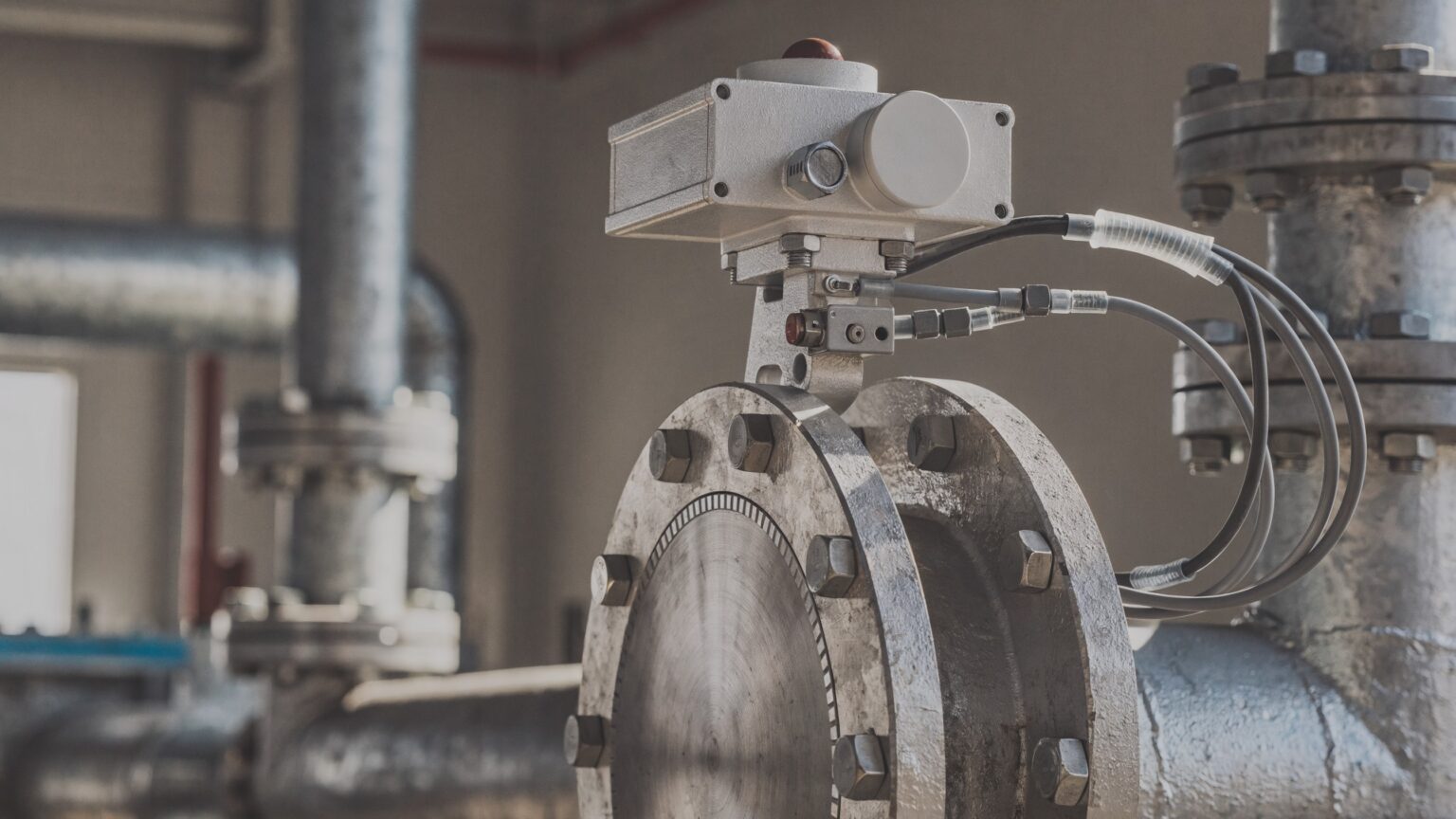
„Absperrklappe mit Antrieb“ – so steht es in vielen Anfragen, und meist fehlt dahinter die Hälfte. Auf jeder unserer Produktseiten für Absperrarmaturen steht dieselbe Zeile: Handbetätigung oder Antrieb, elektrisch, pneumatisch oder hydraulisch. Welche dieser Möglichkeiten zu Ihrer Einbaustelle passt, steht dort nicht. Genau diese Entscheidung behandelt dieser Beitrag. Sie fällt nicht am Antrieb selbst, sondern an fünf Fragen zur Anlage: Welche Hilfsenergie liegt an? Welche Bewegung braucht die Armatur? Wie schnell muss sie schalten? Welche Stellung soll sie einnehmen, wenn die Energie ausfällt? Und welches Drehmoment verlangt sie bei Nennweite und Differenzdruck? Es geht hier um Auf-Zu-Antriebe für Absperrklappen, Absperrschieber, Kugelhähne und Absperrventile. Stellantriebe für Regelventile sind ein eigenes Thema mit anderen Anforderungen an Genauigkeit und Stellsignal.
Absperrklappe mit Antrieb: zuerst die Hilfsenergie klären
In Bestandsanlagen liegt die halbe Antwort schon an der Einbaustelle. Gibt es dort ein Druckluftnetz mit aufbereiteter Steuerluft, liegt der pneumatische Antrieb nahe. Gibt es nur Strom, ist es in aller Regel der elektrische. Hydraulik kommt in Frage, wenn ein Hydraulikaggregat ohnehin vorhanden ist oder wenn die Kräfte so groß sind, dass die anderen beiden Antriebsarten unhandlich werden. Eine neue Druckluft- oder Hydraulikleitung quer durch die Anlage zu verlegen, kostet oft mehr als der Preisunterschied zwischen zwei Antrieben. Deshalb lohnt der Blick auf die vorhandene Energie, bevor über Stellzeiten und Drehmomente gesprochen wird.
Bei Druckluft zählt nicht nur, dass sie da ist, sondern in welcher Qualität. Feuchte Steuerluft führt im Freien zu Kondensat, das in Leitungen und Magnetventilen gefrieren kann. Öl oder Partikel in der Luft setzen den Dichtungen im Antrieb zu. Welche Luftqualität der jeweilige Antrieb verlangt, steht in der Herstellerangabe. Sie gehört zur Planung, nicht erst zur Inbetriebnahme.
Schwenk-, Dreh- oder Schubantrieb: welche Bewegung die Armatur braucht
Bevor die Energieart feststeht, muss die Bewegung klar sein. Absperrklappen und Kugelhähne schalten mit einer Vierteldrehung, also 90 Grad. Sie brauchen einen Schwenkantrieb. Die Schnittstelle zwischen Armatur und Schwenkantrieb ist in der EN ISO 5211 genormt: Flanschgröße, Lochkreis und Wellenaufnahme. Hat die Armatur einen Kopfflansch nach dieser Norm, passt ein Antrieb mit gleicher Flanschgröße ohne Zwischenstück.
Absperrschieber und Absperrventile mit Spindel brauchen dagegen viele Umdrehungen oder einen geraden Hub. Dafür gibt es Drehantriebe, die mehrere Umdrehungen ausführen, mit Anschluss nach EN ISO 5210, oder bei Ventilen auch Schubantriebe. Ein pneumatischer Zylinder auf einem großen Schieber braucht die volle Hubhöhe über der Armatur. Das ist an engen Einbaustellen oft der Punkt, an dem die Wahl auf einen elektrischen Drehantrieb fällt.
Bei einer Nachrüstung ist die erste Frage daher, ob die vorhandene Armatur eine genormte Antriebsschnittstelle hat. Fehlt sie, braucht es eine Kupplung mit Laterne, und deren Ausführung hängt an Wellenform, Drehrichtung und Einbaulage.
Pneumatischer Antrieb: doppelt wirkend oder mit Federrückstellung
Pneumatische Schwenkantriebe gibt es in zwei Grundformen. Der doppelt wirkende Antrieb bekommt Luft für beide Richtungen. Fällt die Luft aus, bleibt er in der letzten Stellung stehen. Der einfach wirkende, federrückstellende Antrieb öffnet oder schließt mit Luft gegen Federn. Fällt die Luft aus, fährt die Federkraft die Armatur in eine festgelegte Stellung, je nach Montage auf oder zu.
Der Federantrieb ist größer als ein doppelt wirkender mit gleichem Nutzmoment, weil die Luft zusätzlich die Feder spannen muss. Und das Federmoment nimmt zum Ende des Federwegs hin ab. Er wird deshalb nicht auf das Moment der Armatur in Ruhe ausgelegt, sondern auf den ungünstigsten Punkt im Schwenkbereich. Bei einer Absperrklappe liegt der meist dort, wo die Scheibe aus dem Sitz losbrechen oder in den Sitz einfahren muss.
Zum pneumatischen Antrieb gehört ein Magnetventil, oft über die NAMUR-Schnittstelle direkt angeflanscht, dazu eine Endlagenschalterbox für die Rückmeldung. Die Stellzeit lässt sich über Drosseln einstellen. Sie sollte auch eingestellt werden: Eine Klappe in einer Flüssigkeitsleitung, die in Sekundenbruchteilen schließt, erzeugt einen Druckstoß, der Leitung und Armatur stärker belastet als jeder Normalbetrieb.
Elektrischer Antrieb: Signal, Endlagen und Stellzeit
Der elektrische Antrieb braucht keine Druckluft und bringt Rückmeldung und Überlastschutz meist schon mit. Die Drehmomentabschaltung stoppt den Motor, wenn die Armatur schwergängig wird oder auf ein Hindernis trifft, statt Welle oder Scheibe zu überlasten. Über ein Handrad lässt sich die Armatur auch ohne Strom bewegen. Angesteuert wird je nach Anlage mit einem einfachen Auf-Zu-Signal, im Dreipunktverfahren oder über einen Feldbus.
Bei der Inbetriebnahme wird festgelegt, ob die Endlagen über den Weg oder über das Drehmoment abgeschaltet werden. Das hängt von der Dichtungsart der Armatur ab und folgt der Angabe des Armaturenherstellers. Eine falsch eingestellte Endlage ist eine der häufigsten Ursachen für undichte Absperrungen nach einem Antriebstausch, obwohl Armatur und Antrieb einwandfrei sind.
Elektrische Antriebe schalten in der Regel langsamer als pneumatische, und bei Stromausfall bleiben sie in der letzten Stellung stehen. Für eine definierte Sicherheitsstellung gibt es Ausführungen mit Federrücklauf oder mit Energiespeicher. Für explosionsgefährdete Bereiche gibt es Antriebe in Ex-Ausführung. Welche Zone an der Einbaustelle gilt, legt der Betreiber fest; der Antrieb wird danach ausgewählt.
Hydraulischer Antrieb: wenn hohe Kräfte und Sicherheitsstellung zusammenkommen
Unsere Absperrklappen reichen bis DN 2500, die Absperrschieber bis DN 1000 und PN 630. In diesen Größen werden die Kräfte so hoch, dass pneumatische Antriebe sehr groß ausfallen und elektrische lange Stellzeiten brauchen. Hydraulische Antriebe bringen hohe Kräfte aus einem kompakten Zylinder. Ein Druckspeicher hält genug Energie vor, um die Armatur auch bei Ausfall der Pumpe in die Sicherheitsstellung zu fahren.
Der Preis dafür ist ein eigenes System: Aggregat, Leitungen, Hydrauliköl, dazu die Kontrolle auf Leckagen. Das lohnt sich dort, wo Hydraulik ohnehin vorhanden ist, etwa im Kraftwerk an Turbinen- und Speisewasserarmaturen, oder wo die geforderte Kraft anders nicht sinnvoll erreichbar ist. Einen Mittelweg bieten elektrohydraulische Kompaktantriebe: Pumpe, Motor und Speicher sitzen im Antrieb selbst, an der Einbaustelle braucht es nur Strom.
Sicherheitsstellung: was bei Energieausfall passieren soll
Diese Frage entscheidet oft mehr als jede andere. Es gibt drei Möglichkeiten: schließen, öffnen oder in der letzten Stellung bleiben. Eine Absperrung in einer Brennstoffleitung soll bei Energieausfall meist schließen, eine Absperrung im Kühlwasser eher öffnen. Welche Stellung richtig ist, ergibt sich aus der Verfahrenstechnik und aus der Gefährdungsbeurteilung der Anlage, nicht aus dem Antriebskatalog.
Steht die Sicherheitsstellung fest, grenzt sie die Auswahl stark ein. Pneumatisch heißt das: federrückstellend. Hydraulisch: mit Speicher oder Feder. Elektrisch: mit Federrücklauf oder Energiespeicher. Wo eine Armatur nicht nur absperren, sondern in kürzester Zeit sicher schließen muss, etwa vor einer Turbine, ist eine eigene Armaturengattung gefragt: unsere Sicherheits- und Schnellschlussventile.
Handrad, Getriebe oder Antrieb: wann keine Automatisierung nötig ist
Nicht jede Armatur braucht einen Antrieb. Revisionsabsperrungen, die ein paar Mal im Jahr betätigt werden, sind mit Handhebel oder Handrad gut versorgt. Bei größeren Klappen übernimmt ein Schneckengetriebe die Untersetzung. Es ist selbsthemmend, hält die Scheibe in jeder Zwischenstellung und zeigt die Stellung an.
Ein Antrieb lohnt sich, wenn die Armatur schwer erreichbar ist, häufig geschaltet wird, aus der Leitwarte bedient werden soll oder bei einer Störung schneller schließen muss, als ein Mensch zur Einbaustelle kommt. Wer heute noch von Hand schaltet, aber später automatisieren will, bestellt die Armatur mit genormtem Kopfflansch. Dann wird aus der Nachrüstung ein Tausch des Getriebes gegen den Antrieb.
Drehmoment und Anfrage: welche Angaben wir brauchen
Der Antrieb wird nach dem Drehmoment der Armatur ausgelegt, und dieses Moment ist keine feste Zahl. Nach längerem Stillstand ist das Losbrechmoment höher als im laufenden Betrieb. Eine weichdichtende Klappe hat einen anderen Momentverlauf als eine doppelt oder vierfach exzentrische mit metallischer Dichtung. Differenzdruck, Medium und Temperatur verschieben die Werte zusätzlich. Die Momentangabe kommt deshalb vom Armaturenhersteller, der Antrieb bekommt eine Reserve darüber.
Für ein belastbares Angebot brauchen wir:
- Armatur: Bauform, Nennweite, Druckstufe und Anschluss, bei einer Nachrüstung zusätzlich Fabrikat und Typ
- Medium, Temperatur und den größten Differenzdruck beim Öffnen und Schließen
- vorhandene Hilfsenergie: Steuerluftdruck, Spannung oder Hydraulikdruck
- geforderte Stellzeit und Sicherheitsstellung bei Energieausfall
- Ansteuerung und Rückmeldung: Auf-Zu, Dreipunkt oder Feldbus, Endlagenschalter
- Einbauort: im Freien oder in der Halle, Umgebungstemperatur, Ex-Zone
Einstellung und Inbetriebnahme übernimmt auf Wunsch unsere eigene Serviceabteilung, einschließlich der Endlagen und der Stellzeit.
Häufige Fragen zur Absperrklappe mit Antrieb
Kann ich einen Antrieb auf eine vorhandene Handklappe nachrüsten?
Meist ja. Hat die Klappe einen Kopfflansch nach EN ISO 5211, wird das Getriebe oder der Handhebel gegen einen Antrieb gleicher Flanschgröße getauscht. Ohne genormte Schnittstelle braucht es eine Kupplung mit Laterne. Vorher muss das Drehmoment der Klappe bekannt sein, bei älteren Armaturen auch ihr Zustand, denn ein schwergängiges Lager wird durch einen Antrieb nicht besser.
Doppelt wirkend oder federrückstellend: was ist üblich?
Das richtet sich nach der Sicherheitsstellung. Muss die Armatur bei Luftausfall in eine bestimmte Stellung fahren, ist der federrückstellende Antrieb die einfache Lösung. Darf sie stehen bleiben, genügt der kleinere doppelt wirkende Antrieb.
Brauche ich einen Stellungsregler?
Für reines Auf-Zu nicht. Endlagenschalter melden die Stellung zurück. Ein Stellungsregler wird erst gebraucht, wenn die Armatur Zwischenstellungen anfahren soll. Dann ist die Frage meist, ob eine Absperrklappe überhaupt die richtige Armatur ist oder eine Drossel- und Regelklappe.
Was wird an einem Antrieb gewartet?
Beim pneumatischen Antrieb die Steuerluftaufbereitung, die Dichtungen im Zylinder und das Magnetventil. Beim elektrischen die Einstellung der Endlagen- und Drehmomentschalter, die Kabeleinführungen und die Schmierung des Getriebes nach Herstellerangabe. Beim hydraulischen kommen Ölstand, Ölzustand und Dichtheit der Leitungen dazu. Bei allen drei gehört die Kupplung zur Armatur mit in die Prüfung.
Fazit: der Antrieb folgt der Anlage
Welcher Antrieb auf die Absperrklappe gehört, entscheidet sich an der Einbaustelle: an der vorhandenen Hilfsenergie, an der Bewegung der Armatur, an der Sicherheitsstellung bei Energieausfall und am Drehmoment unter echten Betriebsbedingungen. Pneumatisch ist schnell und mit Feder einfach abzusichern, elektrisch braucht nur Strom und bringt Rückmeldung mit, hydraulisch trägt die großen Kräfte. Die Ing. Wilhelm Friedrich Gesellschaft m. b. H. liefert Absperrklappen, Absperrschieber, Kugelhähne und Absperrventile mit Handbetätigung oder mit Antrieb in allen drei Antriebsarten, ist seit 1983 am österreichischen Markt, seit 2019 in Südosteuropa und hat seit 2021 eine eigene Serviceabteilung. Anfragen zur Auslegung: Ing. Wilhelm Friedrich Gesellschaft m. b. H., Gewerbegebiet 10, 2100 Stetten, Telefon +43 2262 63510, armaturen@fribi.at.
Butterfly valve with actuator: pneumatic, electric or hydraulic — which actuator for which duty
“Butterfly valve with actuator” is how many enquiries reach us, and usually half the information is missing. Every one of our product pages for isolating valves carries the same line: manual operation or actuator, electric, pneumatic or hydraulic. Which of these suits your installation point is not stated there, and that decision is what this article is about. It is not made at the actuator itself but by five questions about the plant: what auxiliary power is available, what movement the valve needs, how fast it has to operate, what position it should take if power fails, and what torque it requires at the given nominal size and differential pressure. The article covers on/off actuators for butterfly valves, gate valves, ball valves and globe isolating valves. Actuators for control valves are a separate subject with different demands on accuracy and control signal.
Start with the auxiliary power
In existing plants half the answer is already at the installation point. If a compressed-air network with treated instrument air reaches it, a pneumatic actuator is the obvious choice. If there is only electricity, it will usually be an electric one. Hydraulics come into question where a hydraulic power unit already exists, or where the forces are so large that the other two types become unwieldy. Running a new air or hydraulic line across the plant often costs more than the price difference between two actuators, so it pays to look at the available energy before discussing operating times and torques.
With compressed air, quality matters as much as availability. Moist instrument air produces condensate outdoors, which can freeze in lines and solenoid valves; oil or particles attack the seals inside the actuator. The required air quality is stated by the actuator manufacturer and belongs in the design stage, not in commissioning.
Quarter-turn, multi-turn or linear: the movement the valve needs
Butterfly valves and ball valves operate with a quarter turn of 90 degrees and need a part-turn actuator. The interface between valve and part-turn actuator is standardised in EN ISO 5211: flange size, bolt circle and drive socket. If the valve has a top flange to this standard, an actuator of the same flange size fits without an adaptor.
Gate valves and globe isolating valves with a stem need many turns or a straight stroke instead. For these there are multi-turn actuators with attachments to EN ISO 5210, and for globe valves also linear actuators. A pneumatic cylinder on a large gate valve needs the full stroke height above the valve, which at cramped installation points is often what tips the choice towards an electric multi-turn actuator. When retrofitting, the first question is whether the existing valve has a standardised actuator interface; if not, a coupling with a mounting bracket is needed, and its design depends on shaft form, direction of rotation and mounting position.
Pneumatic actuators: double-acting or spring-return
Pneumatic part-turn actuators come in two basic forms. A double-acting actuator receives air for both directions; if the air fails, it stays where it is. A single-acting, spring-return actuator opens or closes with air against springs; if the air fails, the springs drive the valve to a defined position, open or closed depending on assembly. The spring-return actuator is larger than a double-acting one of the same output, because the air also has to compress the springs, and spring torque falls off towards the end of the spring stroke. It is therefore sized for the least favourable point of the travel, which on a butterfly valve is usually where the disc breaks out of or seats into the seal.
A pneumatic actuator is fitted with a solenoid valve, often mounted directly via the NAMUR interface, and a limit switch box for position feedback. Operating time is set with throttles — and it should be set: a valve in a liquid line that closes in a fraction of a second causes a pressure surge that loads line and valve more than any normal operation.
Electric actuators: signal, end positions and operating time
An electric actuator needs no compressed air and usually includes feedback and overload protection. Torque switching stops the motor when the valve becomes stiff or meets an obstruction, instead of overloading shaft or disc, and a handwheel allows operation without power. Control is by a simple open/close signal, three-point control or fieldbus. During commissioning it is decided whether the end positions are switched off by travel or by torque; this depends on the valve’s sealing design and follows the valve manufacturer’s instructions. A wrongly set end position is one of the most common causes of a leaking shut-off after an actuator change, even though valve and actuator are both in order.
Electric actuators generally operate more slowly than pneumatic ones, and on power failure they stay in their last position. For a defined safety position there are versions with spring return or an energy store. For potentially explosive atmospheres explosion-protected versions are available; the zone at the installation point is set by the operator, and the actuator is selected accordingly.
Hydraulic actuators: high forces with a safety position
Our butterfly valves go up to DN 2500, our gate valves up to DN 1000 and PN 630. At these sizes the forces become so high that pneumatic actuators get very large and electric ones need long operating times. Hydraulic actuators deliver high forces from a compact cylinder, and an accumulator holds enough energy to drive the valve to its safety position even if the pump fails. The price is a separate system — power unit, lines, hydraulic oil and checks for leaks. That pays off where hydraulics already exist, for example on turbine and feedwater valves in power plants, or where the required force cannot sensibly be reached otherwise. Electro-hydraulic compact actuators are a middle way: pump, motor and accumulator sit inside the actuator, and the installation point needs only electricity.
Safety position: what should happen on power failure
This question often decides more than any other. There are three options: close, open or stay put. An isolating valve in a fuel line will usually be required to close on power failure, one in a cooling water line rather to open. The correct position follows from the process design and the plant’s risk assessment, not from the actuator catalogue. Once it is fixed, it narrows the choice considerably: spring-return for pneumatic, accumulator or spring for hydraulic, spring return or energy store for electric. Where a valve must not just isolate but close safely within the shortest time, for instance upstream of a turbine, a separate valve type is called for: our safety and quick-closing valves.
Handwheel, gearbox or actuator
Not every valve needs an actuator. Isolating valves for maintenance that are operated a few times a year are well served by a lever or handwheel; on larger butterfly valves a worm gearbox provides the reduction, is self-locking, holds the disc in any intermediate position and indicates its position. An actuator pays off where the valve is hard to reach, operates frequently, is to be controlled from the control room, or must close faster in an upset than a person can reach it. If you operate manually today but plan to automate later, order the valve with a standardised top flange — the retrofit then becomes an exchange of gearbox for actuator.
Torque and enquiry: the information we need
The actuator is sized on the valve torque, and that torque is not a fixed number. After a long standstill the breakaway torque is higher than in running operation; a soft-seated butterfly valve has a different torque curve from a double- or quadruple-offset valve with metal seating; differential pressure, medium and temperature shift the values further. The torque figure therefore comes from the valve manufacturer, and the actuator is given a margin above it. For a firm quotation we need the valve type, nominal size, pressure rating and connection (for a retrofit also make and model); medium, temperature and the highest differential pressure on opening and closing; the available auxiliary power; the required operating time and safety position; control and feedback; and the installation conditions, including ambient temperature and explosion zone. Setting-up and commissioning, including end positions and operating time, can be carried out by our own service department.
Frequently asked questions
Can an actuator be retrofitted to an existing manual butterfly valve?
Usually yes. If the valve has a top flange to EN ISO 5211, the gearbox or lever is replaced by an actuator of the same flange size; without a standardised interface a coupling with bracket is needed. The valve torque must be known beforehand, and on older valves their condition too — a stiff bearing does not improve with an actuator.
Double-acting or spring-return: what is usual?
That depends on the safety position. If the valve has to move to a defined position on air failure, the spring-return actuator is the simple solution. If it may stay where it is, the smaller double-acting actuator is sufficient.
Do I need a positioner?
Not for pure on/off duty; limit switches report the position. A positioner is needed only when the valve has to reach intermediate positions — and then the question is often whether a butterfly isolating valve is the right valve at all, or a throttling and control damper.
What is maintained on an actuator?
On pneumatic actuators the air treatment, the cylinder seals and the solenoid valve; on electric actuators the setting of the limit and torque switches, the cable entries and gearbox lubrication as specified by the manufacturer; on hydraulic actuators also oil level, oil condition and the tightness of the lines. In all three cases the coupling to the valve is part of the inspection.
Who to contact
Ing. Wilhelm Friedrich Gesellschaft m. b. H., Gewerbegebiet 10, 2100 Stetten, Austria, phone +43 2262 63510, armaturen@fribi.at. The company has served the Austrian market since 1983, south-east Europe since 2019, and has had its own service department since 2021.
