Feintrockner im Dampfnetz: was er abscheidet, wo er sitzt und wann er sich rechnet
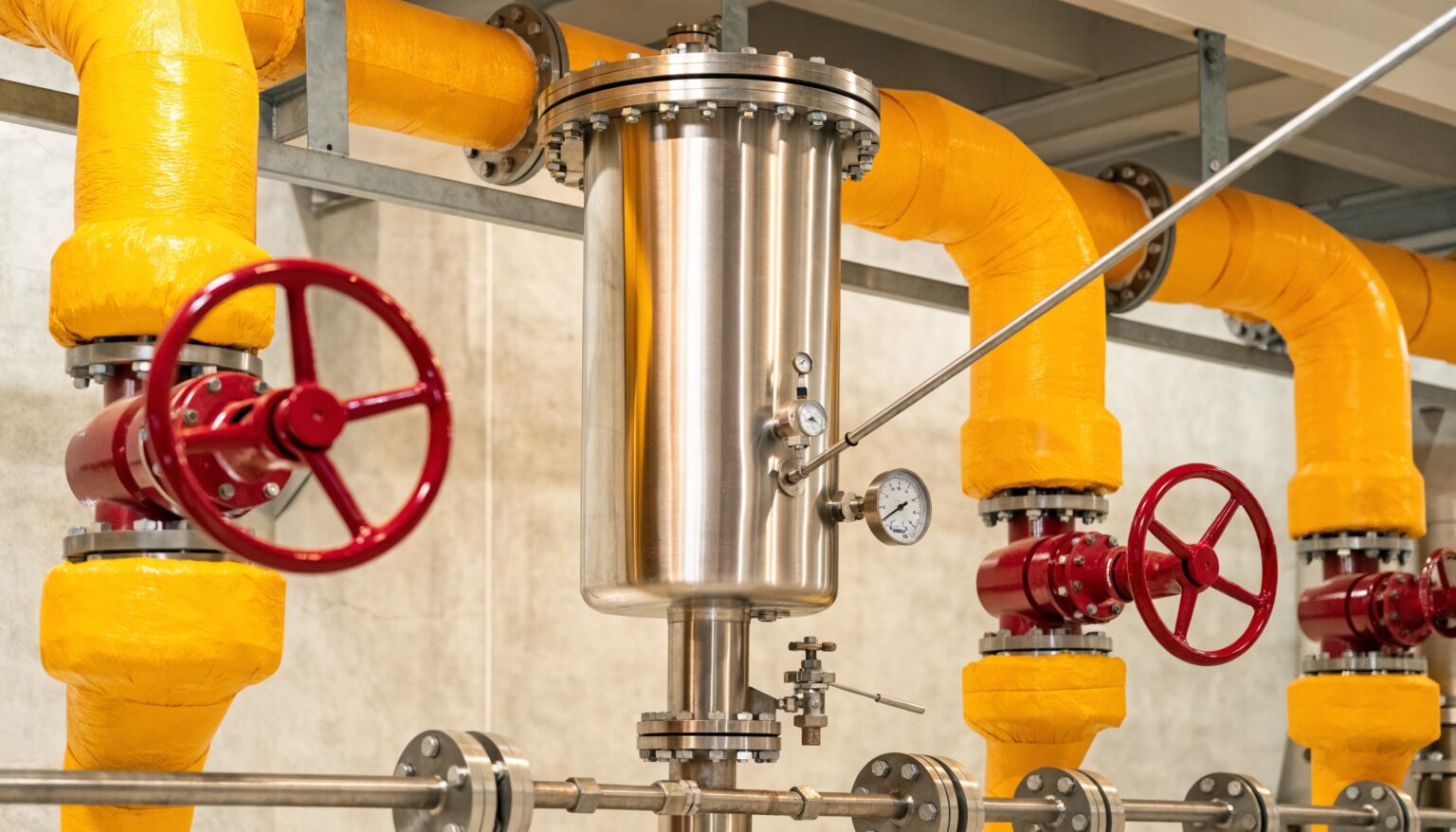
Ein Feintrockner steht selten im Lastenheft und fast nie im Störungsprotokoll. Trotzdem entscheidet er mit darüber, ob am Regelventil, am Dampfinjektor oder am Wärmetauscher trockener Dampf ankommt oder ein Gemisch, das die Armatur von innen auswäscht. Dieser Beitrag beantwortet drei Fragen, die in der Planung regelmäßig zusammenfallen: Was scheidet ein Feintrockner ab, das ein Abscheider nicht schafft, an welcher Stelle im Netz gehört er eingebaut, und ab wann trägt er sich über Erosion, Leckdampf und Standzeiten.
Was ein Feintrockner im Dampfnetz abscheidet
Sattdampf ist nie ganz trocken. Im Kessel reißt das siedende Wasser feinste Tropfen mit, auf dem Weg durch das Netz kommt Kondensat aus dem Wandfilm dazu, und jeder Leitungsabschnitt, der auskühlt, erzeugt neues. Der Trockengehalt am Verbraucher liegt in vielen Netzen zwischen 0,95 und 0,98. Zwei bis fünf Prozent des Massenstroms, der am Ventil ankommt, sind also flüssiges Wasser.
Ein Abscheider holt davon den groben Anteil heraus: Tropfen ab etwa 10 Mikrometer, die sich durch Umlenkung, Zyklonwirkung oder Prallblech aus der Strömung schleudern lassen. Was übrig bleibt, ist ein Nebel aus Tropfen im Bereich weniger Mikrometer. Diese Tropfen folgen der Strömung, weil ihre Masse zu klein ist, um bei einer Richtungsänderung auszuscheren. Ein größerer Abscheider ändert daran wenig, weil das Trennprinzip an der Trägheit hängt und diese Tropfen praktisch keine haben.
Genau dort setzt der Feintrockner an. Er arbeitet nicht über Massenträgheit, sondern über Berührung. Ein Gestrick- oder Drahtnetzpaket zwingt den Dampf auf eine Vielzahl kurzer, enger Wege. Die feinen Tropfen legen sich an die Drähte, wachsen dort zu größeren Tropfen zusammen und laufen als Film nach unten in den Sammelraum ab. Aus dem Nebel wird abführbares Kondensat. Erreichbar sind damit Trockengehalte um 0,99 und darüber, abhängig von Anströmgeschwindigkeit, Bauform und Vorabscheidung.
Abscheider, Schmutzfänger, Feintrockner: drei Bauteile, drei Aufgaben
In Ausschreibungen werden die drei regelmäßig gegeneinander ausgespielt, obwohl sie unterschiedliche Dinge tun.
- Der Schmutzfänger hält Feststoffe zurück: Zunder, Schweißperlen, Rost, Dichtungsreste. Er schützt Sitzflächen und vor allem das Gestrick des Trockners vor dem Zusetzen. Schrägsitz- und Hochdruckausführungen stehen bei den diversen Armaturen.
- Der Abscheider trennt grobe Tropfen und Schwallwasser ab. Er ist die erste Stufe und kommt mit hohen Wasseranteilen zurecht, ohne zu fluten.
- Der Feintrockner nimmt den Rest, also den Nebel, der beide anderen ungehindert passiert.
Damit ist die Reihenfolge vorgegeben: Schmutzfänger, Abscheider, Feintrockner, dann der Verbraucher. Wer den Trockner ohne Vorabscheidung einbaut, betreibt ihn als Abscheider. Das Gestrick flutet, die Abscheideleistung bricht ein und der Druckverlust steigt. Wer ihn ohne Schmutzfänger einbaut, tauscht das Paket früher als geplant.
Wo der Feintrockner im Netz sitzt
Die Faustregel lautet: so nah wie möglich an dem Verbraucher, der trockenen Dampf braucht. Jeder Meter Rohr hinter dem Trockner erzeugt wieder Kondensat. Typische Einbaustellen sind:
- vor Regel- und Schnellschlussventilen, deren Sitz- und Kegelgeometrie für Dampf ausgelegt ist und nicht für ein Zweiphasengemisch;
- vor Turbinen und Dampfmotoren, wo Tropfen auf die Beschaufelung treffen;
- vor Dampfinjektoren und Direktdampfeinbringung, wo Wasser im Mischbereich Schläge auslöst;
- vor Messstellen, weil eine Blende oder ein Wirbelzähler das mitgeführte Wasser als Dampf mitmisst und dadurch zu hohe Mengen ausweist;
- vor Trocknungs-, Sterilisations- und Kontaktheizprozessen, bei denen die Restfeuchte im Produkt sichtbar wird.
Nach einer Druckreduzierung liegt der Fall anders. Beim Drosseln über ein Reduzierventil bleibt die Enthalpie annähernd erhalten, während die Verdampfungsenthalpie beim niedrigeren Druck kleiner wird. Der Dampf wird dabei trockener, unter Umständen sogar leicht überhitzt. Wenn es um die Dampfqualität am Ventil selbst geht, gehört der Feintrockner deshalb vor die Reduzierstufe und nicht dahinter. Geht es um die Qualität am Verbraucher hinter der Station, entscheidet die Rohrstrecke dazwischen.
In jedem Fall gilt: Der Ablauf des Trockners braucht einen eigenen Kondensatableiter. Ein Feintrockner ohne funktionierende Entwässerung ist ein Behälter, der sich füllt. Für den Dauerablauf kleiner Mengen ist ein Schwimmerableiter die naheliegende Wahl, weil er kontinuierlich und ohne Aufstau arbeitet. Die Bauarten stehen auf der Seite Kondensattechnik nebeneinander; welche davon wofür passt und woran die Auswahl in der Praxis scheitert, steht im Beitrag Kondensatableiter: Auswahl, Bauarten und die häufigsten Fehler.
Dampfqualität in Zahlen: vom Trockengehalt zur Restfeuchte
Trockener Dampf ist keine Eigenschaft, sondern eine Zahl. Der Trockengehalt gibt den Massenanteil Dampf am Gesamtmassenstrom an, die Restfeuchte ist der Rest. In einer Leitung mit 1.000 kg/h bedeutet das:
- Trockengehalt 0,95 entspricht 50 kg/h flüssigem Wasser.
- Trockengehalt 0,98 nach einem gut ausgelegten Abscheider: noch 20 kg/h.
- Trockengehalt 0,99 und besser nach dem Feintrockner: 10 kg/h oder weniger.
Die Differenz wirkt klein, sie wirkt aber an zwei Stellen gleichzeitig. Erstens fehlt die Verdampfungsenthalpie: Wasser, das bereits flüssig ankommt, gibt am Wärmetauscher nichts mehr ab. Fünf Prozent Restfeuchte bedeuten rund fünf Prozent weniger nutzbare Wärme je Kilogramm. Zweitens, und das wiegt im Betrieb schwerer, legt sich das Wasser als Film auf die Heizfläche und wirkt dort als zusätzlicher Wärmewiderstand. Der Leistungsverlust am Apparat fällt deshalb regelmäßig größer aus als der rechnerische Enthalpieverlust.
Für die laufende Messung der Restfeuchte gibt es keine einfache Standardlösung. Belastbar sind zwei indirekte Wege: die Kondensatmenge am Trocknerablauf und die Überwachung der Ableiter selbst. Ultraschall- und Temperaturmesstechnik dafür steht unter Messtechnik.
Was feuchter Dampf an Sitz, Kegel und Rohrbogen anrichtet
Tropfen im Dampf sind ein mechanisches Problem, kein thermisches. Im Drosselspalt eines Regelventils erreicht die Strömung sehr hohe Geschwindigkeiten, und die mitgeführten Tropfen treffen mit dieser Geschwindigkeit auf Sitzkante und Kegelkontur. Das Schadensbild ist charakteristisch:
- Riefen und Auswaschungen am Sitz, meist radial ausgerichtet an der Stelle der engsten Drosselung. Die Armatur schließt nicht mehr dicht, lange bevor mechanisch etwas defekt ist.
- Abtrag an der Kegelkontur, der die Kennlinie verändert. Die Regelung wird im unteren Hubbereich ungenau, der Arbeitspunkt wandert.
- Erosion am Rohrbogen hinter der Armatur, außen an der Krümmung, wo die Tropfen durch ihre Trägheit auftreffen. Eine Wandstärkenmessung an genau dieser Stelle ist bei Verdacht die erste Maßnahme.
- Schläge beim Anfahren, wenn sich in der ausgekühlten Leitung Wasser gesammelt hat und die anlaufende Dampfströmung es als Pfropfen beschleunigt.
Ein Sitz, der wegen Erosion nicht mehr dicht schließt, ist nicht zwangsläufig ein Fall für eine neue Armatur. Sitz und Kegel lassen sich in vielen Fällen nacharbeiten, das gehört zu den Aufgaben unserer Serviceabteilung. Sinnvoll ist eine Nacharbeit aber nur, wenn gleichzeitig die Ursache abgestellt wird. Sonst steht dieselbe Armatur zwei Jahre später wieder auf der Werkbank.
Auslegung und Einbau: die Punkte, an denen es schiefgeht
- Nach Geschwindigkeit auslegen, nicht nach Nennweite. Das Gestrick arbeitet in einem Geschwindigkeitsfenster. Unterhalb davon treffen zu wenige Tropfen auf die Drähte, oberhalb davon reißt die Strömung den bereits abgeschiedenen Film wieder mit. Beides liefert nasse Dampfqualität, ohne dass am Bauteil ein Fehler sichtbar wäre.
- Den Teillastfall mitrechnen. Netze, die zwischen 20 und 100 Prozent fahren, verlassen das Fenster nach unten. Dann ist eine Aufteilung auf zwei parallel geschaltete Trockner oder eine andere Bauform die ehrlichere Lösung als ein einzelnes, auf Volllast gerechnetes Gerät.
- Einbaulage einhalten. Der Sammelraum muss unten liegen und der Ablauf nach unten frei sein. Ein Trockner, der aus Platzmangel gedreht eingebaut wird, entwässert nicht mehr.
- Differenzdruck als Zustandsgröße mitführen. Ein sauberes Paket hat einen kleinen, stabilen Druckverlust. Steigt er über die Monate an, setzt sich das Gestrick zu. Das ist das einzige frühe Signal, das ein Feintrockner überhaupt gibt.
- Werkstoff und Druckstufe nach dem Anfahrfall wählen. Maßgeblich ist nicht der stationäre Betriebspunkt, sondern der ungünstigste Zustand beim Anfahren und beim Lastwechsel.
- Absperrung und Entleerung vorsehen. Ein Paket, das sich nur bei entleerter Leitung tauschen lässt, wird nicht getauscht.
Wann sich ein Feintrockner rechnet
Die Rechnung läuft nicht über den Preis des Bauteils, sondern über drei Posten, die ohne ihn anfallen.
Leckdampf. Der häufigste Folgeschaden nasser Dampfqualität ist ein überlasteter oder verschlissener Kondensatableiter. Ein durchblasender Ableiter setzt erhebliche Mengen frei: Eine Öffnung von 3 mm bei 10 bar Überdruck lässt überschlägig rund 30 kg Dampf pro Stunde ab. Bei Dauerbetrieb sind das etwa 240 Tonnen im Jahr, und zwar je Ableiter.
Standzeit der Armaturen. Erosion an Sitz und Kegel ist der Grund, warum Regelventile in nassen Netzen früher undicht werden als im Datenblatt vorgesehen. Wer die Wartungsintervalle einer Armatur kennt, kennt damit auch den Betrag, der auf der anderen Seite der Rechnung steht.
Prozess- und Produktqualität. In Trocknungs-, Sterilisations- und Kontaktheizprozessen schlägt die Restfeuchte direkt auf das Ergebnis durch. Dort ist der Feintrockner keine Verbesserung, sondern Teil der Spezifikation.
Als Orientierung: Sobald an einer Stelle ein Regelventil, eine längere Vorleitung und ein Verbraucher mit Qualitätsanforderung zusammentreffen, ist die Frage nicht mehr ob, sondern welche Bauform. Für alles darunter reichen in vielen Fällen ein Abscheider und ein ordentlich ausgelegter Ableiter.
Häufige Fragen zum Feintrockner
Brauche ich zusätzlich zum Abscheider wirklich einen Feintrockner?
Das hängt davon ab, was hinter der Stelle steht. Für eine Begleitheizung oder einen unkritischen Wärmetauscher genügt der Abscheider. Sobald ein Regelventil, eine Turbine, eine Messstelle oder ein qualitätsrelevanter Prozess folgt, ist der Feinanteil genau das, was dort Schaden anrichtet, und den bekommt der Abscheider prinzipbedingt nicht heraus.
Woran erkenne ich im laufenden Betrieb, dass der Dampf zu nass ist?
An vier Hinweisen: auffällig hoher Kondensatanfall an den Ableitern vor dem Verbraucher, wandernde Regelabweichungen an einem Ventil, das mechanisch in Ordnung ist, Schläge beim Anfahren, und Messwerte am Durchfluss, die dauerhaft über der Bilanz liegen. Einzeln ist jeder Punkt erklärbar, gemeinsam sind sie ein deutliches Bild.
Kann ein Feintrockner den Kondensatableiter ersetzen?
Nein, er braucht selbst einen. Der Trockner sammelt das abgeschiedene Wasser, führt es aber nicht ab. Ohne funktionierende Entwässerung steigt der Pegel im Sammelraum bis ins Gestrick, und ab diesem Punkt arbeitet das Gerät gegen sich selbst.
Wie oft muss das Gestrickpaket getauscht werden?
Ein festes Intervall gibt es nicht, weil die Standzeit an der Feststofffracht hängt. Die belastbare Größe ist der Differenzdruck über dem Trockner. Solange er auf dem Niveau der Inbetriebnahme bleibt, ist das Paket in Ordnung. Ein vorgeschalteter Schmutzfänger verlängert dieses Intervall deutlich.
Feintrockner vor oder nach der Druckreduzierung?
Wenn das Reduzierventil selbst geschützt werden soll, davor. Wenn der Verbraucher hinter der Station den trockenen Dampf braucht und zwischen Station und Verbraucher eine längere Leitung liegt, spricht einiges für eine zweite Stufe unmittelbar vor dem Verbraucher.
Fazit: die Entscheidung in drei Schritten
Erstens: Klären Sie, was hinter der Stelle steht. Regelventil, Turbine, Messstelle oder qualitätsrelevanter Prozess sprechen für einen Feintrockner, eine unkritische Beheizung nicht.
Zweitens: Prüfen Sie die Kette davor. Ohne Schmutzfänger und Abscheider ist der Trockner falsch eingesetzt, und ohne eigenen Kondensatableiter am Ablauf ist er wirkungslos.
Drittens: Legen Sie nach Geschwindigkeit und nach dem Teillastfall aus, nicht nach der Nennweite der Leitung, und sehen Sie den Differenzdruck als Zustandsgröße vor.
Wenn Sie uns Betriebsdruck, Massenstrom, Lastbereich und die Stelle im Netz nennen, lässt sich die Bauform rechnen. Aus dem RIFOX-Programm, das wir für Österreich vertreten, stehen die passenden Feintrockner und Feinfilter in der Kondensattechnik; Auslegung, Inbetriebnahme und spätere Nacharbeit übernimmt unsere Serviceabteilung.
Steam dryers: what they remove, where they belong and when they pay off
A fine steam dryer rarely appears in a specification and almost never in a fault report. It nevertheless decides whether a control valve, a steam injector or a heat exchanger receives dry steam, or a two-phase mixture that washes the trim out from the inside. This article answers three questions that planners tend to run together: what does a fine dryer remove that a separator cannot, where in the network does it belong, and at what point does it pay for itself through erosion, steam loss and service life.
What a fine dryer actually removes
Saturated steam is never completely dry. Boiling water in the boiler entrains fine droplets, the wall film adds condensate along the way, and every length of pipe that cools down produces more. In many networks the dryness fraction at the consumer lies between 0.95 and 0.98. Two to five per cent of the mass flow arriving at the valve is therefore liquid water.
A separator removes the coarse share: droplets from roughly 10 micrometres upwards, which can be thrown out of the flow by a change of direction, a cyclone or a baffle. What remains is a mist of droplets a few micrometres across. These droplets follow the flow because their mass is too small to leave it at a bend. A larger separator changes little, because the separating principle relies on inertia and these droplets have almost none.
This is where the fine dryer works. It does not rely on inertia but on contact. A knitted mesh or wire pack forces the steam through a large number of short, narrow paths. The fine droplets settle on the wires, coalesce into larger drops and run down as a film into the collecting chamber. Mist becomes condensate that can be drained. Dryness fractions of 0.99 and above are achievable, depending on approach velocity, design and upstream separation.
Strainer, separator, fine dryer: three components, three jobs
Tenders regularly play these three off against each other, although they do different things.
- The strainer holds back solids: scale, weld spatter, rust, gasket debris. It protects seating surfaces and above all keeps the dryer mesh from blinding. Y-type and high-pressure versions are listed under miscellaneous valves.
- The separator removes coarse droplets and slugs of water. It is the first stage and copes with high water content without flooding.
- The fine dryer takes what is left, namely the mist that passes both of the others untouched.
The order follows from that: strainer, separator, fine dryer, then the consumer. Installing the dryer without upstream separation means running it as a separator. The mesh floods, separation efficiency collapses and pressure drop rises. Installing it without a strainer means replacing the pack earlier than planned.
Where the dryer sits in the network
The rule of thumb is: as close as possible to the consumer that needs dry steam, because every metre of pipe downstream produces condensate again. Typical locations are upstream of control and quick-closing valves, upstream of turbines and steam engines, upstream of steam injectors and direct steam injection, upstream of flow measurement, where entrained water is counted as steam and inflates the reading, and upstream of drying, sterilising and contact heating processes, where residual moisture shows up in the product.
Downstream of a pressure reducing station the situation differs. Throttling across a reducing valve keeps enthalpy roughly constant while the latent heat at the lower pressure is smaller, so the steam becomes drier and may even leave the valve slightly superheated. If the aim is steam quality at the valve itself, the dryer belongs upstream of the reducing stage, not downstream. If the aim is quality at a consumer behind the station, the length of pipe in between decides.
In every case the dryer drain needs a steam trap of its own. A fine dryer without working drainage is a vessel that fills up. For continuous removal of small quantities a float trap is the obvious choice because it drains continuously and without backing up. The types are shown side by side on the condensate technology page, which also lists fine dryers and fine filters under accessories.
Steam quality in numbers: from dryness fraction to residual moisture
Dry steam is not a property, it is a figure. The dryness fraction gives the mass share of steam in the total mass flow, residual moisture is the remainder. In a line carrying 1,000 kg/h that means a dryness fraction of 0.95 corresponds to 50 kg/h of liquid water, 0.98 after a well sized separator leaves 20 kg/h, and 0.99 or better after the fine dryer leaves 10 kg/h or less.
The difference looks small but acts in two places at once. First the latent heat is missing: water that already arrives in liquid form releases nothing at the heat exchanger, so five per cent residual moisture means roughly five per cent less usable heat per kilogram. Second, and this weighs more heavily in operation, the water forms a film on the heating surface and acts there as an additional thermal resistance. The loss of output at the apparatus is therefore regularly larger than the calculated loss of enthalpy.
There is no simple standard method for measuring residual moisture during operation. Two indirect routes are reliable: the amount of condensate at the dryer drain, and monitoring of the traps themselves. Ultrasonic and temperature instrumentation for this purpose is listed under measurement technology.
What wet steam does to seat, plug and pipe bend
Droplets in steam are a mechanical problem, not a thermal one. In the throttling gap of a control valve the flow reaches very high velocities, and the entrained droplets strike the seat edge and the plug contour at that velocity. The damage pattern is characteristic:
- Grooves and wash-outs at the seat, usually radial, at the point of narrowest throttling. The valve no longer shuts tight long before anything is mechanically broken.
- Material loss on the plug contour, which changes the characteristic. Control becomes imprecise in the lower travel range and the operating point drifts.
- Erosion in the pipe bend downstream of the valve, on the outside of the curve where inertia carries the droplets into the wall. Wall thickness measurement at exactly this point is the first step when wet steam is suspected.
- Water hammer on start-up, when water has collected in a cold line and the starting steam flow accelerates it as a slug.
A seat that no longer shuts tight because of erosion is not automatically a case for a new valve. Seat and plug can often be reworked, which is one of the tasks of our service department. Rework only makes sense, however, if the cause is removed at the same time. Otherwise the same valve is back on the bench two years later.
Sizing and installation: where it goes wrong
- Size by velocity, not by nominal diameter. The mesh works within a velocity window. Below it too few droplets reach the wires, above it the flow re-entrains the film that has already been separated. Both deliver wet steam without any visible fault on the component.
- Include the part load case. Networks running between 20 and 100 per cent leave the window at the bottom end. Splitting the duty across two parallel dryers or choosing a different design is then the more honest solution than a single unit sized for full load.
- Observe the installation position. The collecting chamber must be at the bottom and the drain free downwards. A dryer turned for reasons of space no longer drains.
- Trend the differential pressure. A clean pack has a small, stable pressure drop. If it rises over the months, the mesh is blinding. That is the only early signal a fine dryer gives at all.
- Select material and pressure rating from the start-up case, not from the steady operating point.
- Provide isolation and drainage, because a pack that can only be changed with the line emptied will not be changed.
When a fine dryer pays off
The calculation does not run through the price of the component but through three items that arise without it.
Steam loss. The most common consequential damage from wet steam is an overloaded or worn steam trap. A trap that blows through releases considerable quantities: an opening of 3 mm at 10 bar gauge lets roughly 30 kg of steam per hour escape. In continuous operation that is about 240 tonnes a year, per trap.
Valve service life. Erosion at seat and plug is the reason control valves in wet networks start leaking earlier than the data sheet suggests. Anyone who knows the maintenance intervals of a valve also knows the figure on the other side of the calculation.
Process and product quality. In drying, sterilising and contact heating processes residual moisture feeds straight through to the result. There the fine dryer is not an improvement but part of the specification.
Frequently asked questions
Do I really need a fine dryer in addition to the separator? It depends on what follows. A trace heating circuit or an uncritical heat exchanger is served by the separator. As soon as a control valve, a turbine, a measuring point or a quality-relevant process follows, the fine fraction is exactly what causes the damage, and a separator cannot remove it.
How do I recognise wet steam in operation? From four signs: unusually high condensate volumes at the traps upstream of the consumer, drifting control deviations on a valve that is mechanically sound, water hammer on start-up, and flow readings that sit permanently above the mass balance. Individually each has other explanations, together they are a clear picture.
Can a fine dryer replace the steam trap? No, it needs one itself. The dryer collects the separated water but does not remove it. Without working drainage the level in the collecting chamber rises into the mesh, and from that point the unit works against itself.
How often does the mesh pack have to be replaced? There is no fixed interval, because service life depends on the solids load. The reliable variable is the differential pressure across the dryer. An upstream strainer extends that interval considerably.
Before or after the pressure reducing stage? Upstream if the reducing valve itself is to be protected. If a consumer behind the station needs the dry steam and a longer run of pipe lies in between, a second stage immediately upstream of the consumer is worth considering.
Conclusion
Decide in three steps. First, establish what follows the location: a control valve, turbine, measuring point or quality-relevant process argues for a fine dryer, an uncritical heating duty does not. Second, check the chain upstream, because without strainer and separator the dryer is misapplied and without its own trap at the drain it is ineffective. Third, size by velocity and by the part load case, and provide for differential pressure as a condition variable.
Send us operating pressure, mass flow, load range and the location in the network and the design can be calculated. From the RIFOX range we represent in Austria, the matching fine dryers and fine filters are part of our condensate technology programme; sizing, commissioning and later rework are handled by our service department.
